
Gemstones come in many colors, shapes, and varieties, but their appearance does not always reveal how they were formed or whether they have undergone treatments. A natural sapphire, a lab-grown sapphire, and a heat-treated sapphire may look remarkably similar, even though their origins and characteristics are different.
Understanding the difference between natural, lab-grown, and treated gemstones is important when purchasing fine jewelry, building a gemstone collection, or maintaining valuable pieces. These distinctions can influence rarity, market demand, care requirements, and how a gemstone is documented.
Although all three categories may appear similar, they describe different aspects of a gemstone. Natural and lab-grown refer to how a gemstone originated, while treated describes modifications made to improve or change certain characteristics.
In this guide, we explain how these gemstones differ, the treatments commonly used in the jewelry industry, and what buyers should understand before purchasing gemstone jewelry.
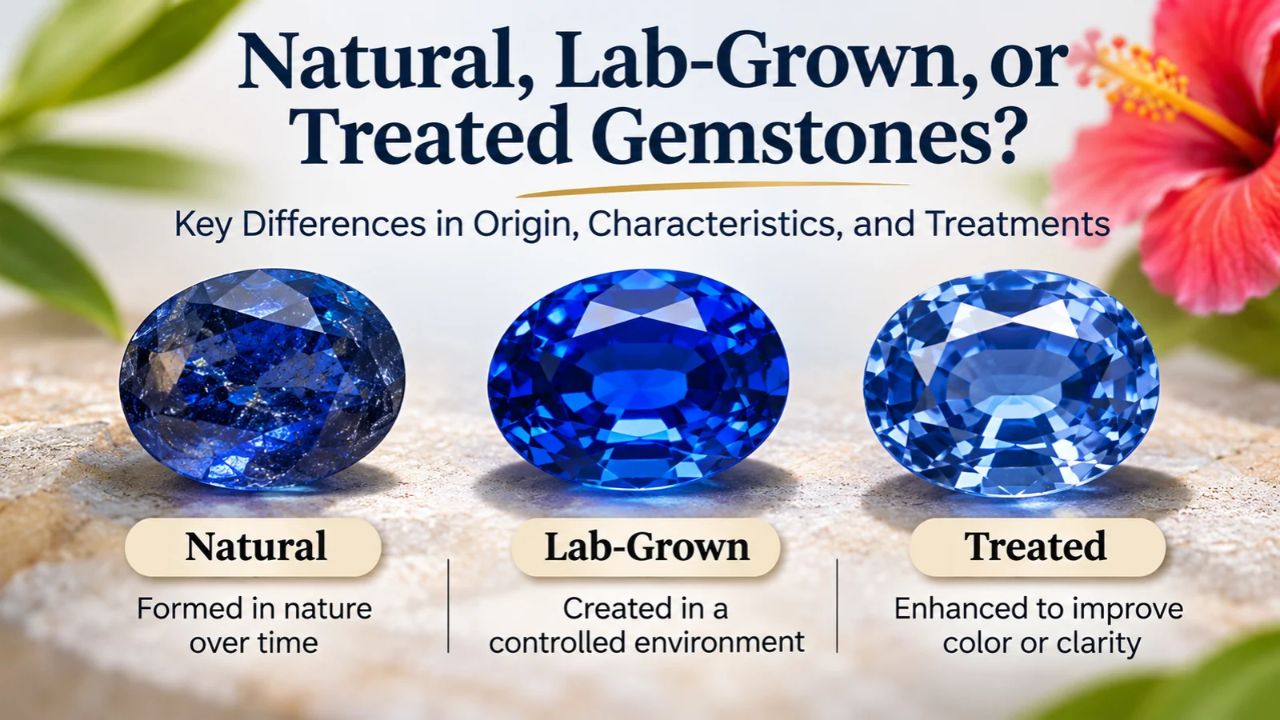
Natural gemstones are minerals or organic materials that form through naturally occurring geological or biological processes. Most mineral gemstones develop beneath the Earth’s surface over thousands or millions of years under specific conditions involving heat, pressure, and chemical elements.
These natural processes create gemstones with distinctive colors, internal structures, and physical characteristics.
Some common examples of natural gemstones include:
One characteristic of natural gemstones is that they may contain inclusions, growth patterns, and other internal features developed during their formation.
These characteristics can help gemologists understand a gemstone’s identity and origin. However, not every natural gemstone contains visible imperfections. Some naturally formed stones have exceptional clarity and appearance.
Natural gemstones are often sought after for their geological history, rarity, distinctive characteristics, and market desirability. However, their value depends on several factors, including quality, size, color, clarity, origin, and consumer demand.
Lab-grown gemstones are created in controlled laboratory environments using specialized equipment and processes that reproduce some of the conditions responsible for natural gemstone formation.
Unlike natural gemstones, which develop through geological processes, lab-grown gemstones are produced through controlled manufacturing techniques.
An important distinction is that lab-grown gemstones are not necessarily imitation stones. Many have essentially the same chemical composition, crystal structure, and physical properties as their corresponding natural gemstone varieties.
For example, a laboratory-grown ruby has the same fundamental mineral composition as a natural ruby. Both are varieties of corundum.
Common methods used to produce lab-grown gemstones include:
The flame fusion method involves melting powdered raw materials through a high-temperature flame. As the molten material cools, crystals gradually form.
This technique is commonly used to manufacture synthetic rubies and sapphires.
The hydrothermal method uses heated, pressurized water containing dissolved minerals to grow crystals.
It recreates certain conditions associated with natural geological environments and is commonly used to produce synthetic emeralds and quartz.
Flux growth involves dissolving gemstone-forming ingredients in a molten substance called flux.
As the mixture cools, crystals gradually develop. This process can produce synthetic gemstones with characteristics that resemble naturally formed stones.
Lab-grown gemstones have become increasingly available in the jewelry market because their production takes place in controlled environments. However, they should always be accurately represented as laboratory-grown rather than natural.
Treated gemstones are stones that have undergone human intervention to improve or modify certain characteristics, such as color, clarity, or overall appearance.
Many gemstones receive treatments to enhance their visual appeal or make them more commercially desirable.
A treated gemstone can be natural or lab-grown. This is an important distinction because treatment describes an alteration, not the gemstone’s original source.
Some treatments are widely accepted in the jewelry industry, while others may require special care or additional disclosure.
Here are some common gemstone treatments.
Heat treatment involves exposing gemstones to controlled temperatures to improve or modify their color and, in some cases, clarity.
This treatment is commonly used for sapphires, rubies, and other colored gemstones.
For example, heating can improve the color appearance of certain sapphires by changing the distribution or chemical state of color-producing elements.
Fracture filling involves introducing a substance into surface-reaching cracks or fractures to make them less visible.
This treatment is commonly associated with emeralds. Oils, resins, or other filling materials may be used depending on the gemstone and treatment process.
The filling material can affect how the gemstone should be cleaned and maintained.
Irradiation involves exposing gemstones to controlled radiation to modify their color.
This technique is used for certain diamonds, topaz, and other gemstones. Some irradiated stones may undergo additional heat treatment to develop or stabilize the desired color.
Surface coating involves applying a thin layer of material to modify a gemstone’s appearance.
Coatings may be used to change color, create optical effects, or enhance the visual appearance of a stone.
However, coated gemstones may require additional care because their surface layers can be vulnerable to scratching, abrasion, and chemicals.
Dyeing involves introducing coloring substances into a gemstone to change or intensify its color.
It is commonly used with certain porous or fractured materials. Depending on the material and treatment, dyes may be affected by cleaning products, chemicals, and prolonged exposure to certain environmental conditions.
Although these three gemstone categories can look similar, they have important differences in origin, production, and treatment history.
| Feature | Natural Gemstones | Lab-Grown Gemstones | Treated Gemstones |
|---|---|---|---|
| Origin | Formed naturally | Created in a laboratory | Can be natural or lab-grown |
| Formation | Geological or natural processes | Controlled manufacturing processes | Original formation followed by treatment |
| Composition | Natural gemstone material | Same fundamental composition as the corresponding natural variety | Depends on the original gemstone |
| Internal characteristics | May contain natural inclusions | May show laboratory growth features | Depends on original material and treatment |
| Appearance | Varies naturally | Can closely resemble natural counterparts | May have enhanced color or clarity |
| Treatment | May be untreated or treated | May be untreated or treated | Has undergone a treatment |
| Market desirability | Depends on rarity, quality, and demand | Depends on quality and market demand | Depends on quality and treatment type |
It is important to understand that these categories are not mutually exclusive.
For example, a sapphire can be natural and heat-treated at the same time. A laboratory-grown gemstone can also undergo additional treatment.
Identifying the origin and treatment status of a gemstone is not always possible through visual inspection alone.
Some laboratory-grown gemstones closely resemble their natural counterparts. Similarly, certain treatments may leave subtle characteristics that require specialized examination.
Gemologists use different techniques and instruments to study gemstone properties and identify evidence of their origin or treatment.
Magnification allows specialists to examine inclusions, fractures, growth structures, and other internal characteristics.
Certain inclusion patterns can provide useful information about whether a gemstone formed naturally or in a laboratory.
Spectroscopy examines how gemstones interact with different wavelengths of light.
The resulting patterns can help identify chemical elements, color origins, and certain treatment-related characteristics.
A refractometer measures how light bends as it passes through a gemstone.
This measurement helps identify gemstone materials and distinguish between certain varieties.
Some gemstones react to ultraviolet light by producing visible fluorescence.
These reactions can provide additional information about a gemstone’s characteristics, although fluorescence alone cannot establish whether a stone is natural, lab-grown, or treated.
For gemstones requiring more detailed identification, laboratories may use advanced instruments to examine chemical composition, trace elements, growth features, and treatment indicators.
The appropriate testing method depends on the gemstone type and the specific characteristics being investigated.
Understanding these examination methods can also help readers better understand the information included in a professional jewelry appraisal process.
Yes. Their market values can differ significantly, but origin and treatment status are only part of the overall evaluation.
Natural gemstones may command higher prices when they possess desirable characteristics such as exceptional color, high clarity, substantial size, rarity, and documented origin.
Lab-grown gemstones are generally more widely available because they can be produced in controlled environments. Their pricing often differs from natural counterparts, although quality, production method, and market demand still matter.
Treated gemstones also vary considerably in market value. Some commonly accepted treatments have established markets, while other treatments may affect desirability, durability, or resale potential.
Several factors influence gemstone value:
For a closer look at the characteristics that influence diamond quality and pricing, read our guide on Understanding Diamond Appraisals: What Really Impacts Value.
A gemstone should not automatically be considered more valuable simply because it is natural. Its overall quality, rarity, condition, and market demand are also important.
Treatment disclosure helps buyers understand exactly what they are purchasing.
A gemstone that has undergone heat treatment, fracture filling, irradiation, or another enhancement may require different care from an untreated stone.
For example, certain emeralds with fracture fillings can be sensitive to heat, chemicals, and some cleaning methods. Similarly, coated gemstones may require additional precautions to prevent damage to their surface layers.
Disclosure is also important when purchasing jewelry, selling gemstones, or maintaining records for an existing collection.
Before purchasing a gemstone, consider asking the seller:
A gemstone grading report can provide useful information about a stone’s identity and characteristics. However, it is not the same as a monetary valuation.
To understand the distinction, read our article Appraisal vs. Grading Report: What’s the Difference?.
Gemstone care depends primarily on the material, its hardness, toughness, and any treatments it has received.
Natural gemstones are not automatically more durable than lab-grown gemstones. Since corresponding natural and laboratory-grown varieties generally share the same fundamental composition and crystal structure, they often have similar physical properties.
Treated gemstones, however, may require additional precautions depending on the enhancement.
Here are some general recommendations:
When in doubt, seek guidance from a qualified jewelry professional before using specialized cleaning methods.
For more practical advice, see our guide to Expert Tips for Maintaining Your Jewelry.
When purchasing or owning fine jewelry, knowing the gemstone’s identity and treatment history can help prevent misunderstandings.
A professional examination may help establish:
If you own a ring containing a gemstone and want to understand how its characteristics are documented, our guide on How to Get an Appraisal on a Ring and Avoid Common Mistakes explains what information may be considered during an examination.
A detailed written report can also help jewelry owners maintain records for insurance, estate planning, and other documentation purposes. You can learn more in our guide to Understanding Your Jewelry Appraisal Report.
Natural, lab-grown, and treated gemstones may appear similar, but their origins and characteristics are different.
Natural gemstones develop through geological processes, lab-grown gemstones are created in controlled environments, and treated gemstones undergo modifications to improve or change certain features.
Understanding these differences is useful when purchasing jewelry, maintaining a gemstone collection, or reviewing existing jewelry records.
If you own gemstones and are unsure about their origin, treatment status, or identifying characteristics, a professional examination can help provide a clearer understanding of what you have.
For jewelry owners in Hawaii, Hawaii Jewelry Appraisal provides professional jewelry appraisal services to help document and assess jewelry. Visit the website to learn more about available appraisal services and appointment options.


